Physical Address
304 North Cardinal St.
Dorchester Center, MA 02124
Physical Address
304 North Cardinal St.
Dorchester Center, MA 02124

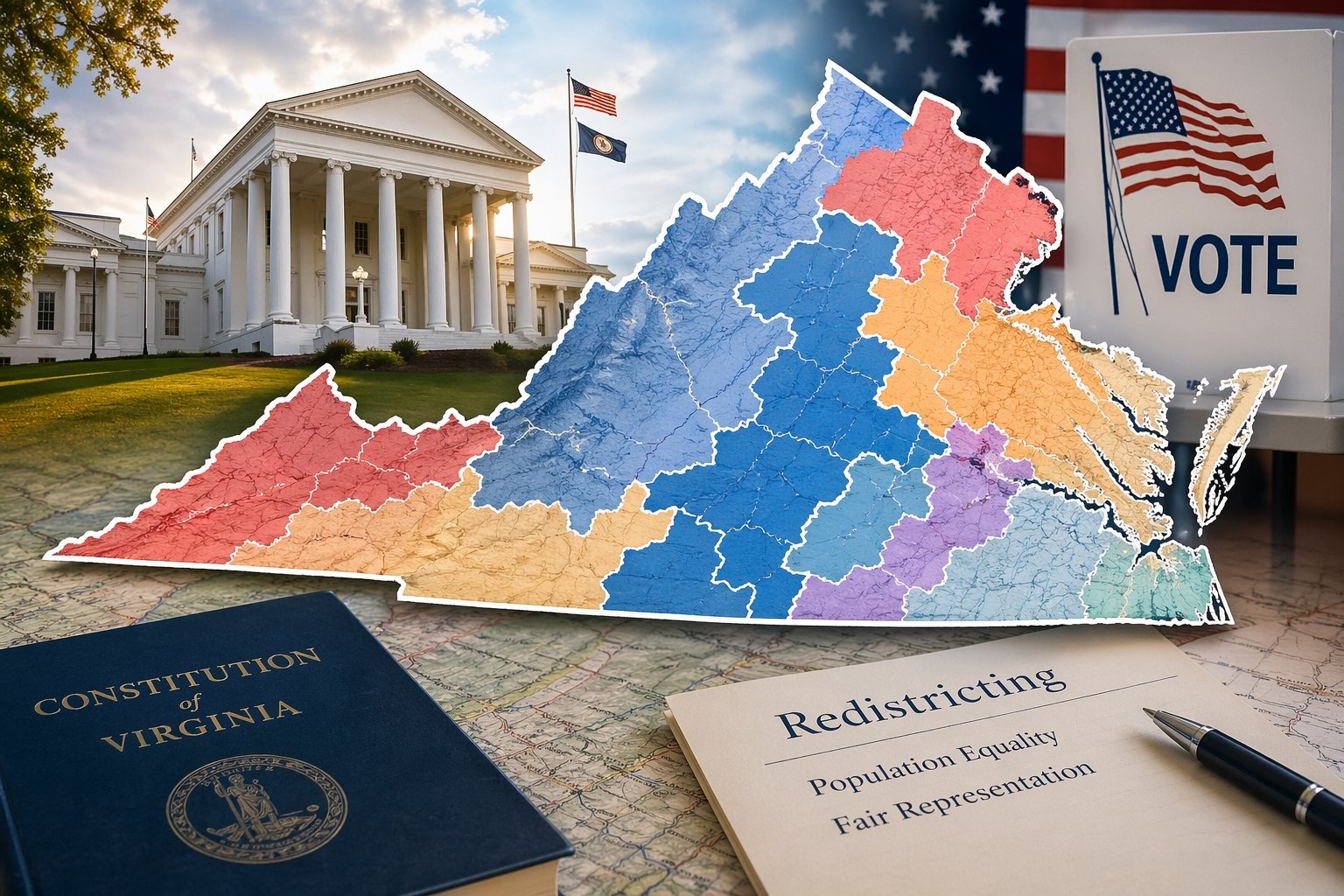
Explore what gerrymandering in Virginia means, how district maps have shaped political power, and why redistricting remains one of the state’s most important democracy debates. This guide covers the history, court cases, reforms, and modern controversies behind Virginia’s voting maps.
When Virginians look at their congressional and legislative districts on a map, they often see lines that zigzag across county boundaries and follow no obvious logic. Gerrymandering — the manipulation of district boundaries to advantage a political party or group — explains many of these irregular shapes and the controversies that surround them. In Virginia, the story of gerrymandering stretches from the earliest days of the republic to today’s battles over who draws the lines. Understanding its history, mechanics and modern reforms provides insight into how redistricting shapes representation and why calls for fair maps continue.
Virginia redraws its congressional and state legislative districts every ten years to reflect population changes after the census. Done correctly, redistricting creates districts that fairly represent communities and reflect population shifts. However, the process has often been exploited. When political leaders draw lines to ensure their party holds power, they rig the system so that politicians choose their voters rather than voters choosing their politicians. In extreme cases, one party can win a majority of seats despite receiving a minority of votes. This long‑form article explores how gerrymandering has operated in Virginia, why it matters and what reforms have been enacted to restore fairness.
Gerrymandering predates its famous name. During the 1788 first congressional election, Virginia’s anti‑Federalist governor Patrick Henry tried to block his rival, James Madison, from winning a seat in the new U.S. House of Representatives. Henry crafted a congressional district that combined five counties — Orange, Albemarle, Spotsylvania, Louisa and Culpeper — to dilute Federalist support for Madison and bolster Anti‑Federalist candidate James Monroe. Although Madison ultimately won the seat, the episode shows how politicians in the founding era already manipulated boundaries to undermine opponents.
The term gerrymander itself came later. In 1812, Massachusetts governor Elbridge Gerry approved a state senate district that snaked through several counties. A newspaper cartoonist likened the contorted district to a salamander; critics dubbed it a “Gerry‑mander,” and the name stuck. This Massachusetts origin story is often cited, but Virginia’s earlier example demonstrates that the practice is older than the label.
Redistricting is a normal democratic process. Every decade, states redraw congressional and legislative districts to equalize populations and ensure that each district represents roughly the same number of people. In Virginia, the ideal district sizes following the 2020 Census were approximately 784,672 people for each of the 11 U.S. House districts, 215,785 people for each of 40 state senate districts and 86,314 people for each of 100 House of Delegates districts. Without redistricting, fast‑growing areas would be underrepresented and slower‑growing areas overrepresented.
Gerrymandering occurs when redistricting is manipulated to favor a particular party or group. There are two primary techniques:
These techniques are often used together, and gerrymandered maps sometimes look deceptively compact. As the Brennan Center notes, neat and square districts can still be gerrymandered if voter data is manipulated; conversely, odd‑shaped districts may simply follow natural boundaries or preserve communities of interest. Modern gerrymandering has become even more precise with sophisticated software that allows map‑drawers to sort voters with “surgical precision”.
A common misconception is that any oddly shaped district is a gerrymander. While unusual shapes can signal manipulation, geography and population distribution sometimes require irregular lines. Conversely, compact maps can conceal carefully engineered partisan advantages. Another misconception is that gerrymandering is always illegal. Courts have consistently held that partisan gerrymandering is a “political question” beyond the reach of federal courts after the U.S. Supreme Court’s 2019 decision in Rucho v. Common Cause. Racial gerrymandering, however, violates the Equal Protection Clause and the Voting Rights Act if race is the predominant factor in drawing a district without a compelling justification. Throughout Virginia’s recent history, courts have struck down racially gerrymandered districts while leaving partisan gerrymanders largely untouched.
In 2012, Virginia redrew its congressional districts to comply with the Voting Rights Act, which then required federal preclearance of changes. To secure preclearance, the state increased the Black voting‑age population of the 3rd Congressional District from 53.1 % to 56.3 %. After the Shelby County v. Holder decision in 2013 invalidated the preclearance formula, several voters sued in Personhuballah v. Alcorn (originally Page v. Virginia State Board of Elections). They argued that by setting a “target” of at least 55 % Black voting‑age population, the state had made race the predominant factor and created an unconstitutional racial gerrymander.
A three‑judge federal panel agreed, ruling in October 2014 that District 3 was an unconstitutional racial gerrymander. The court held that the state’s use of race was not narrowly tailored because it maintained an excessive minority percentage rather than simply preserving minority voters’ ability to elect their candidate of choice. After the U.S. Supreme Court vacated the decision and remanded the case for reconsideration in light of Alabama Legislative Black Caucus v. Alabama — which clarified that equalizing populations cannot be the “predominant” factor and that the Voting Rights Act does not require maintaining a specific minority percentage — the district court again struck down the plan and appointed a special master to draw a remedial plan. The Supreme Court eventually dismissed the appeal for lack of standing, leaving the new map in place.
The Personhuballah case demonstrates how the use of race to “pack” minority voters can violate constitutional protections even when the stated goal is compliance with voting rights law. It also underscores that courts may intervene to remedy racial gerrymanders even as they decline to police partisan ones.
In 2014, voters in twelve House of Delegates districts brought a lawsuit alleging that the 2011 map unconstitutionally packed African‑American voters into certain districts. They argued that the General Assembly had set a racial target of 55 % Black voting‑age population for each district, diluting Black voting power elsewhere and violating the Equal Protection Clause. The state contended that maintaining this percentage was necessary to preserve minority communities’ ability to elect their preferred candidates.
A three‑judge federal panel initially upheld eleven of the twelve districts, but the U.S. Supreme Court vacated the decision in 2017. The Court held that the panel applied the wrong standard by requiring plaintiffs to prove that a district violated traditional redistricting principles before considering whether race predominated. The Court clarified that even if a district respects traditional principles, it can still be unconstitutional if race was the primary factor. On remand, the panel ruled that all eleven challenged districts were racially gerrymandered and ordered the General Assembly to create a remedial map. When the legislature failed to agree on a new map, the court appointed a special master whose plan was used in the 2019 elections.
Bethune‑Hill demonstrates that racial gerrymanders are subject to strict scrutiny and can be struck down even if map‑drawers claim they are protecting minority voters. The decision set important precedent that would influence later redistricting cycles in Virginia and other states.
For decades, Virginia’s General Assembly and governor controlled redistricting, often drawing lines that entrenched incumbent power. In response to public frustration with partisan gerrymanders, reform advocates pushed for a constitutional amendment to create a bipartisan redistricting commission. The amendment appeared on the November 2020 ballot as Question 1. The ballot asked voters whether to establish a commission consisting of eight legislators and eight citizens responsible for drawing the state’s congressional and legislative districts and to give the Supreme Court of Virginia power to draw districts if the commission or General Assembly failed.
Under the proposed law, the commission would draw maps and submit them to the General Assembly for an up‑or‑down vote without amendments. If the commission could not agree on maps by specified deadlines or if the legislature rejected them, the responsibility would shift to the Supreme Court of Virginia. The amendment created a selection process for citizen commissioners: a committee of five retired circuit court judges would pick eight citizens from lists submitted by legislative leaders. For a map to advance, at least six of the eight citizen commissioners and six of the eight legislative commissioners would need to agree. The amendment also required districts to be contiguous and compact, to have equal populations and to provide opportunities for racial and ethnic communities to elect candidates of their choice.
Voters approved the amendment by a wide margin, shifting the initial line‑drawing authority from politicians to a mixed commission and providing a judicial fallback. Many reformers celebrated the change as a historic victory against gerrymandering. However, the success of the commission would soon be tested.
Supporters of the 2020 amendment, including organizations like OneVirginia2021 and FairMaps Virginia, argued that it would increase transparency and reduce partisan manipulation. They pointed to decades of gerrymanders — from the 2011 Republican‑drawn maps that courts later struck down for racial gerrymandering to earlier Democratic maps that cemented incumbents — and contended that an independent process would produce fairer maps.
Opponents, including some civil rights groups and Democratic lawmakers, warned that the commission could still deadlock and that giving final authority to the Supreme Court of Virginia — whose members are elected by the legislature — did not remove politicians from the process. They also expressed concern that the amendment did not guarantee diverse representation among citizen commissioners. In the end, the public’s desire for reform outweighed these concerns, and the commission became part of the state constitution.
The newly created Virginia Redistricting Commission convened in 2021 to draw new congressional, state senate and House of Delegates maps using 2020 Census data. The commission comprised eight citizen members and eight legislators — four Democrats and four Republicans from each chamber. Its meetings were public, and map proposals were shared online. Despite the commission’s transparency, partisan divisions quickly emerged.
Republican and Democratic members submitted competing proposals, with each side accusing the other of favoring its party. Although statistical analyses of the draft maps suggested they were largely free of one‑party bias, commissioners disagreed over how to prioritize competitiveness, compactness and communities of interest. The commission failed to reach the supermajority required to submit maps to the General Assembly. When deadlines passed without agreement, redistricting authority shifted to the Supreme Court of Virginia.
Virginia’s constitution required the Supreme Court to appoint two special masters — one nominated by Democrats and one by Republicans — to develop proposed maps. The court rejected the initial nominees due to conflict‑of‑interest concerns and ultimately selected Bernard Grofman and Sean Trende, two political scientists and redistricting experts. The court directed the special masters to work together rather than as partisan advocates and barred them from drawing districts to favor any political party.
The special masters released draft maps in November 2021. Their proposals prioritized population equality, compactness and keeping jurisdictions whole. In some cases, they combined cities like Martinsville and Danville or consolidated Lynchburg into a single district to create competitive seats. The final maps adopted by the court placed Charlottesville and Albemarle County into two House districts rather than fragmenting them among four rural districts, a move that balanced community cohesion with fairness. Political analyst Larry Sabato noted that the court faced a dilemma between holding another election under delayed maps or ensuring one‑person–one‑vote representation; he asked whether “the chaos [was] worth it”.
The 2021 court‑drawn maps were widely praised for their fairness. A 2023 article in the Richmond Public Interest Law Review concluded that statistical analyses showed little partisan bias in the commission and special‑master maps, in stark contrast to the racially gerrymandered maps of the previous cycle. The maps advanced the goals of minority representation, competitiveness and partisan neutrality. Advocacy groups such as the Princeton Gerrymandering Project gave the maps high marks for partisan balance and community preservation.
Nonetheless, some localities expressed frustration. Residents of Charlottesville and Albemarle County argued that they deserved a congressman who represented their views. Rural voters feared losing influence in districts dominated by urban areas. Balancing these competing interests remains a challenge whenever lines are redrawn. Overall, Virginia’s experience showed that independent map‑drawing can produce fairer outcomes but cannot satisfy every constituency.
Barely five years after approving the redistricting commission, Virginia lawmakers proposed another constitutional amendment. They argued that mid‑decade gerrymanders enacted in states like North Carolina, Texas and Florida were reshaping national representation, and Virginia needed flexibility to respond. The proposed amendment, scheduled for a special election on April 21 2026, would temporarily allow the General Assembly to adopt new congressional districts before the 2030 census. After the 2030 census, control would revert to the commission.
Supporters contend that allowing the legislature to act now is necessary to counter aggressive gerrymanders in other states and restore fairness at a national level. They frame the amendment as a defensive measure that will protect Virginia voters from being disadvantaged in the U.S. House. House Speaker Don Scott highlighted that the Virginia Supreme Court’s decision allowing the referendum ensures voters, not judges, will decide the state’s course.
Opponents argue that the amendment amounts to a partisan power grab. Because Democrats control both chambers of the General Assembly in 2026, critics say the plan would let Democrats draw a congressional map that favors their party until 2030. Independent analysts note that the proposed map passed by the legislature ahead of the referendum is widely considered a Democratic gerrymander. Legal challenges have already been filed, and lower courts initially blocked the referendum. However, the Virginia Supreme Court ruled that courts should not interfere with the constitutional amendment process and allowed the vote to proceed, emphasizing that judges should not stop citizens from voting on proposed amendments. The court explicitly stated that it was not weighing the legality of the amendment itself but deferring that question until after the vote.
The referendum raises fundamental questions about who controls redistricting in Virginia and whether temporary legislative control is justified to counter national partisan maneuvers. If the amendment passes, the new map would apply to the 2026, 2028 and 2030 elections. If voters reject it, the commission‑drawn 2021 map will remain in place until 2032. The outcome will not only affect Virginia’s representation in Congress but may signal whether voters trust the commission process or prefer giving lawmakers temporary power to respond to out‑of‑state gerrymanders. The campaign leading up to the vote has drawn national attention, with prominent political figures urging Virginians to vote for or against the amendment. Regardless of the result, further litigation is almost certain.
Gerrymandering undermines the principle of representative democracy by predetermining electoral outcomes. When map‑drawers pack or crack voters, they create districts where one party is guaranteed victory even if public opinion shifts. The Brennan Center notes that gerrymandered maps can enable a party to win a majority of seats while receiving only a minority of votes. In Virginia, the 2011 maps gave Republicans significant advantages in the House of Delegates. After Democrats won a statewide majority of votes in 2017, Republicans still held a majority of seats due to favorable district lines.
Racial gerrymandering can dilute the influence of minority voters by concentrating them in a few districts. In the 2011 House of Delegates map, lawmakers purposefully packed African‑American voters into districts with at least 55 % Black voting‑age population. This strategy reduced Black voters’ influence in surrounding districts while creating safe seats where their votes exceeded what was necessary to elect preferred candidates. Similarly, increasing the Black voting‑age population of the 3rd Congressional District in 2012 to 56.3 % concentrated Black voters and limited their statewide impact. Courts have ruled that such racial targets are unconstitutional absent a compelling justification.
Gerrymandered maps often disregard communities of interest by combining distant or dissimilar areas. Before the 2021 redistricting, the 5th Congressional District stretched from Fauquier County to North Carolina, linking Charlottesville and Albemarle County with rural areas that shared little besides geography. Residents complained that their representative could not simultaneously address urban and rural concerns. Similarly, some House districts before 2021 divided cities like Lynchburg and Martinsville among multiple districts, diluting local voices. Disparities in district population due to delayed redistricting also violate the “one person, one vote” principle; in 2021, House District 87 had 130,221 residents while District 75 had only 67,985.
Manipulated maps erode public trust in the political system. When districts are drawn to predetermine outcomes, citizens may feel their votes do not matter. The fight over the 2026 amendment has further polarized voters, with each side accusing the other of seeking unfair advantages. Restoring confidence requires transparent processes, clear criteria and impartial line‑drawing.
Virginia’s 2020 reforms show that independent or bipartisan commissions can reduce gerrymandering, especially when combined with judicial oversight. The commission’s failure to reach consensus led to court‑drawn maps that independent analysts deemed fair. Giving courts the final say, however, is not a panacea; judges are appointed by politicians and may be reluctant to make partisan rulings. Moreover, independent commissions must be truly independent — some reform advocates argue that Virginia’s commission still gives legislators too much power and should be restructured to include only citizens.
Because the U.S. Supreme Court has declined to police partisan gerrymandering, reformers have turned to Congress. The proposed Freedom to Vote Act would prohibit partisan gerrymandering, ban mid‑decade redistricting and establish clear standards for map‑drawing. It would also strengthen protections for minority voters and require greater transparency in the redistricting process. Although the bill passed the House of Representatives, it stalled in the Senate and has not become law. Should it pass in the future, it could provide uniform national standards and reduce reliance on state‑by‑state battles.
Some scholars suggest that the best way to eliminate gerrymandering is to move beyond single‑member districts. Proportional representation systems, where parties win seats roughly in proportion to their vote share, and ranked‑choice voting, which allows voters to rank candidates, could make line‑drawing less consequential. The Richmond Public Interest Law Review article recommended adopting multimember districts with a single transferable vote to increase fairness. While such reforms would require significant legal changes, they are gaining attention as ways to make elections more reflective of voter preferences.
Citizen activism was pivotal in passing the 2020 amendment. Organizations like OneVirginia2021 mobilized volunteers, gathered signatures and educated voters about the importance of fair maps. Continued vigilance is essential. Activists must monitor the commission’s work, submit public comments and hold legislators accountable. In 2021, hundreds of Virginians submitted comments to the special masters urging them to preserve communities of interest. Without public engagement, even well‑designed processes can be co‑opted.
Advances in technology can be used to prevent gerrymandering rather than enable it. Sophisticated algorithms can generate thousands of potential maps based on neutral criteria, enabling independent analysts to score proposals for fairness. Publicly accessible mapping tools allow citizens to draw and submit alternative plans. The Princeton Gerrymandering Project and other universities provide objective evaluations of proposed maps, applying metrics like the efficiency gap, partisan bias and competitiveness. Encouraging the use of such tools in public hearings can increase transparency and trust.
Redistricting is the legally mandated process of redrawing district boundaries after the census to equalize populations. Gerrymandering is manipulating that process to favor a political party or group. Gerrymandered maps often crack or pack voters to create safe seats.
Racial gerrymandering is unconstitutional if race predominates without a compelling justification, as seen in Personhuballah and Bethune‑Hill. Partisan gerrymandering is not barred by federal courts, but Virginia law requires that maps not unduly favor or disfavor any party. The Virginia Constitution and Voting Rights Act also impose constraints.
The commission consists of eight legislators and eight citizens selected by retired judges from lists provided by party leaders. A supermajority of six citizens and six legislators is needed to approve a map. If the commission deadlocks or the General Assembly rejects the maps, the Supreme Court of Virginia draws the districts.
Despite transparency, partisan divisions prevented commissioners from agreeing on final maps. Each side prioritized different criteria such as competitiveness and community preservation. When deadlines passed, redistricting authority shifted to the Supreme Court.
The Supreme Court appointed two special masters, Bernard Grofman and Sean Trende, to craft impartial maps. They were instructed to work together, avoid partisan considerations and prioritize equal population, compactness and communities of interest.
The amendment would temporarily allow the General Assembly to adopt new congressional districts before the 2030 census. Supporters say this flexibility is needed to counter gerrymanders in other states, while opponents view it as a partisan power grab. Voters will decide its fate in a special election on April 21 2026.
By packing minority voters into a few districts, gerrymanderers can dilute their influence in surrounding areas. The 2011 House of Delegates map’s 55 % Black voting‑age population targets and the 2012 District 3 increases illustrate how racial gerrymandering limits statewide impact. Courts have ruled such practices unconstitutional.
The proposed Freedom to Vote Act would ban partisan gerrymandering and impose national standards. However, the bill has stalled in Congress. Federal action remains uncertain, leaving states like Virginia to pursue their own reforms.
Gerrymandering in Virginia is as old as the republic and as contemporary as the 2026 referendum. From Patrick Henry’s attempt to thwart James Madison to the racially gerrymandered maps of 2011, politicians have manipulated district lines to gain advantage. Virginians responded by creating a bipartisan commission to draw fair maps, only to see the commission deadlock and the Supreme Court draw districts that analysts lauded for fairness. Now, the state faces another crossroads as voters weigh whether to give lawmakers temporary map‑drawing power again.
Understanding the mechanics and history of gerrymandering helps citizens grasp what is at stake. Fair representation depends on transparent, impartial processes that respect communities and uphold one‑person–one‑vote. While no system can satisfy every constituency, reforms like independent commissions, judicial oversight and potential federal standards offer hope. As Virginians cast ballots in the 2026 referendum, they not only decide the shape of their districts but affirm whether democracy should be responsive to the people or manipulated by those in power. Continued public engagement and vigilance are essential to ensure that the promise of fair maps becomes a reality. Readers interested in exploring related topics — from the Voting Rights Act to modern reform movements — can find further deep dives on VeroFox.