Physical Address
304 North Cardinal St.
Dorchester Center, MA 02124
Physical Address
304 North Cardinal St.
Dorchester Center, MA 02124

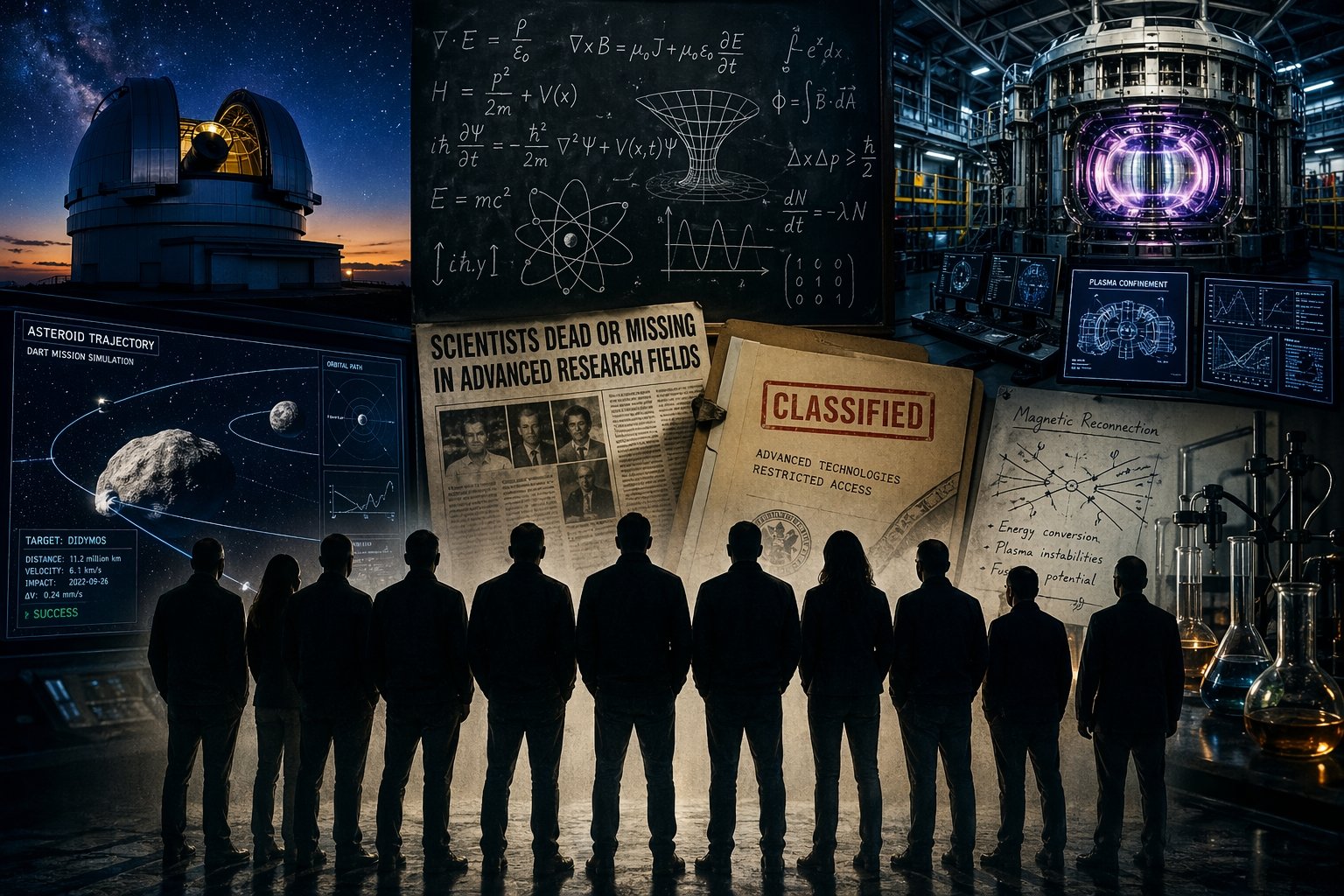
A deep look at the scientists whose deaths or disappearances have fueled public curiosity, including the advanced physics, space, fusion and defense research they were known for. This article helps readers separate the real scientific work from speculation.
The past few years have seen a troubling pattern: highly accomplished researchers in advanced physics, space science and high‑security engineering have either died unexpectedly or disappeared without explanation. News reports and social media speculation have grouped these cases together, hinting at conspiracies and cover‑ups. In reality, these individuals were associated with a wide range of institutions and disciplines, and their cases remain unconnected. This article examines who these scientists were and, more importantly, explores the research they pursued. By understanding their work—ranging from protecting Earth from asteroids to developing new rocket materials—we can separate fact from speculation and appreciate the scientific legacies they left behind.
In early 2026, headlines began circulating about nearly a dozen American scientists who had died or vanished in the previous three years. Several were involved in space exploration, nuclear science or defense‑related research. President Donald Trump acknowledged the concern and said federal agencies would investigate. Members of Congress called on the FBI, NASA and the Department of Energy to determine whether any common threads existed. At time of writing, investigators have released no evidence that the cases are linked. Family members of some missing researchers have pushed back against UFO‑related speculation, and most deaths appear to result from homicide or suicide rather than foul play. Still, the clustering of losses has generated public interest and underscores the risks faced by scientists working at the frontier of knowledge.
Before exploring individual cases, it helps to consider why the coincidence of multiple tragedies can appear suspicious. Researchers in high‑stakes fields often work under intense pressure to publish, secure grants and manage complex projects. A commentary from RAND notes that burnout rates among university staff are comparable to those of high‑risk professions; academic researchers report heavy workloads, job insecurity and work–family conflict as major stressors. Poor mental‑health support can lead to hidden suffering. When combined with the possibility of personal crises or external violence, the tragic deaths and disappearances of several scientists—close together in time—can seem mysterious even when the underlying causes differ. Rather than fueling conspiracy theories, this article focuses on the scientists’ contributions and the circumstances known from public records.
Some of the most notable cases involve scientists engaged in planetary science and astrophysics. These researchers worked on projects meant to understand our solar system, protect the planet from asteroids and unlock the physics of fusion. Their accomplishments extend far beyond the headlines.
Michael David Hicks was a research scientist at NASA’s Jet Propulsion Laboratory, where he studied the physical properties of comets and asteroids. Hicks spent much of his career analysing observations from missions such as Deep Space 1 and serving as a science team member for the Double Asteroid Redirection Test (DART), NASA’s first experiment to deflect an asteroid. His work helped plan mission trajectories and interpret data from near‑Earth objects. Colleagues recall his artistic side—he played the ukulele during observing runs at Mount Palomar. Hicks died on 30 July 2023 at age 59; no cause of death has been publicly disclosed. While some commentators have grouped him into a “missing scientists” narrative, official sources simply note his passing and celebrate his contributions to planetary defence.
Frank Maiwald, a principal researcher at NASA/JPL, died on 4 July 2024 at age 61. Maiwald designed critical remote‑sensing instruments for space missions, including devices that gather multispectral imagery of Earth’s surface. According to a summary by Colorado Politics, he was working on NASA’s upcoming Surface Biology and Geology mission at the time of his death. Colleagues credit Maiwald with advancing satellite systems that detect atmospheric pollutants and search for evidence of life on other planets. Like Hicks, his passing was noted by colleagues but not accompanied by an official cause of death. His career illustrates the complex instrumentation work that enables breakthroughs in Earth observation.
Nuno Loureiro was a Portuguese plasma physicist who joined the Massachusetts Institute of Technology in 2016 and, in 2024, became director of MIT’s Plasma Science and Fusion Center. Loureiro’s research illuminated the behaviour of magnetised plasmas in both fusion reactors and astrophysical settings. An MIT obituary reported that he died on 16 December 2025 from gunshot wounds sustained the previous evening. Loureiro helped explain plasma turbulence and magnetic reconnection, which are essential for improving confinement in fusion devices. He also developed quantum‑computing algorithms for simulating plasma physics. Colleagues described him as a brilliant scientist and compassionate mentor. His death, which occurred after a shooting spree by a suspect who then died by suicide, shocked the international fusion community.
Carl Grillmair was an astronomer at Caltech who spent nearly three decades at the university’s Infrared Processing and Analysis Center. Grillmair’s research spanned exoplanet atmospheres, galactic structure and the remnants of ancient collisions between the Milky Way and smaller galaxies. A California Tech memorial notes that he discovered dozens of stellar streams and led a landmark 2007 study that captured enough light from exoplanets to identify molecules in their atmospheres. He was also involved in NASA missions including the Spitzer Space Telescope, NEOWISE and the forthcoming Near‑Earth Object Surveyor. Grillmair was shot and killed at his rural home in Llano, California, on 16 February 2026; authorities later arrested a 29‑year‑old local resident and said no clear motive was known. His colleagues remember him as a creative scientist and an avid pilot.
These space‑focused researchers shared a commitment to understanding cosmic phenomena and protecting Earth. Their deaths, though unrelated, highlight the human dimension of scientific exploration. Behind each mission acronym—NEOWISE, DART or fusion—are individuals who dedicated their careers to solving problems that affect humanity’s future. Recognising their contributions helps ensure they are remembered for their scientific legacies rather than as mere entries in a list of tragedies.
The next set of cases involves scientists and administrators connected to the U.S. nuclear complex. Los Alamos National Laboratory and the Kansas City National Security Campus support the National Nuclear Security Administration (NNSA) by developing and managing materials for nuclear weapons. Several individuals with ties to these facilities vanished in 2025.
On 8 May 2025, the Los Alamos Police Department issued a missing‑person notice for Anthony Chavez. The department reported that Chavez’s family and friends considered his disappearance “out of character” and asked the public for help locating the 78‑year‑old, who had last been seen leaving his home on foot. Chavez had retired from Los Alamos National Laboratory in 2017 after decades of work. Colleagues say he was an engineer who supported high‑energy physics experiments and explosives safety programmes. His case remains unsolved, and authorities have not suggested foul play.
Monica Reza served as director of materials processing at NASA/JPL and oversaw a government‑funded rocket materials project. She had previously worked at Wright‑Patterson Air Force Base and collaborated with retired Major General William McCasland. News reports indicate that Reza disappeared on 22 June 2025 while hiking in California’s Angeles National Forest. A companion saw her 30 feet behind on the trail, smiling, before she vanished. Search teams combed the area for days, but her body was never recovered. As of April 2026, she remains missing. Authorities have not revealed a motive, and some observers have linked her disappearance to her high‑level security clearance. However, no evidence has emerged to support those theories.
Melissa Casias, 53, worked as an administrative assistant at Los Alamos National Laboratory. She vanished on 26 June 2025 after dropping lunch off to her daughter. Family members discovered that both her personal and work phones had been factory reset, and her car and personal belongings remained at home. Colorado Politics reports that she was last seen walking along a highway without her phone, wallet or keys. Investigators have not revealed whether her position granted her access to sensitive information, and they have not linked her disappearance to any broader pattern.
Steven Garcia, 48, worked as a property custodian for the Kansas City National Security Campus, a Department of Energy facility operated by Honeywell that produces non‑nuclear components for U.S. nuclear weapons. According to Colorado Politics, he was last seen leaving his Albuquerque home on foot on 28 August 2025, carrying only a handgun. Because property custodians are responsible for tracking and securing sensitive components, Garcia’s disappearance raised concerns. The Kansas City National Security Campus stated that it could not confirm whether he had the clearance level reported in the media. At the time of writing, he remains missing.
These cases share two features: each individual either worked at or had ties to facilities involved in nuclear or defense programmes, and each disappearance lacked an obvious motive. However, there is no confirmed evidence that their careers were the cause of their fates. Still, their stories highlight the need for transparency and support for employees in high‑security environments. Facilities such as the Kansas City National Security Campus emphasise a culture of inclusion and community impact, but they also operate under strict secrecy, which can hamper public understanding of employee disappearances.
Amy Eskridge’s case has captured the imagination of conspiracy theorists because she openly discussed anti‑gravity research and claimed to have inside knowledge of UFO programmes. Eskridge co‑founded the Institute for Exotic Science in Huntsville, Alabama, aiming to provide a public interface for experimental propulsion concepts and anti‑gravity technology. She argued in a 2020 interview that several researchers had independently discovered anti‑gravity but were suppressed by government agencies. In June 2022, she died of a self‑inflicted gunshot after warning friends that she felt threatened. Her father, a retired NASA engineer, and colleagues have struggled to reconcile her death with her passion for disclosure. While her research aims were unconventional, there is no evidence that she was harmed because of her scientific work. Her story does, however, underline the dangers faced by researchers who speak openly about fringe technologies in a climate of online harassment.
William Neil McCasland served as commander of the Air Force Research Laboratory at Wright‑Patterson Air Force Base from 2011 to 2013 and later oversaw classified space weapons programmes. He worked closely with NASA and Air Force teams on advanced propulsion and hypersonic projects. On 27 February 2026, McCasland left his Albuquerque home on foot with a sidearm and disappeared. His wife has said he did not want to be found and discouraged speculation about UFOs. The Bernalillo County Sheriff’s Office continues to treat the case as a missing‑person investigation. McCasland’s disappearance stands apart because he was not a civilian scientist but rather a retired military leader with access to classified programmes. Conspiracy theorists have linked his case to purported government knowledge of unidentified anomalous phenomena, but authorities emphasise that there is no evidence of foul play.
Jason Thomas was a Novartis pharmaceutical researcher with advanced degrees in physics, biology and biophysics. He contributed to drug‑discovery programmes aimed at treating cancer and autoimmune diseases. Thomas disappeared from his home in Wakefield, Massachusetts, on 12 December 2025. On 17 March 2026, his body was recovered from Lake Quannapowitt, and an obituary described his death as unexpected. Colorado Politics reports that he had been missing for three months and worked on cutting‑edge chemical biology. As with other cases, there is no public evidence that his death was connected to his research. Nonetheless, his cross‑disciplinary background shows how advanced physics principles can inform pharmaceutical innovation—an area seldom mentioned in conspiracy discussions.
The clustering of these deaths and disappearances has prompted calls for official investigations. In March 2026, Representative Eric Burlison and other lawmakers urged the FBI to investigate “deeply concerning” cases. The House Oversight Committee requested briefings from the FBI, NASA, the Department of Defense and the Department of Energy to identify any commonalities. President Donald Trump publicly stated that he hoped the pattern was a coincidence. So far, no agency has identified a link among the cases, and most remain open investigations.
Numerous online posts have tied these tragedies to topics such as UFO disclosure, antigravity suppression and secret weapons programmes. Yet several facts contradict the notion of a coordinated plot:
While conspiracies may be unfounded, the spate of tragedies raises legitimate questions about the pressures faced by scientists. Academic and research careers involve intense competition, long hours, uncertain funding and high expectations for productivity. RAND researchers observe that the well‑being of academic staff is worse than that of individuals in other occupations and that burnout levels resemble those of health‑care workers. Surveys show that university staff report high demands, limited managerial support and unclear roles. Early‑career researchers often face job insecurity, leading to stress and depression.
Institutions such as MIT, Caltech and Los Alamos National Laboratory have begun expanding mental‑health services for staff and students. Efforts include confidential counselling, peer‑support networks and training for supervisors to recognise signs of distress. On a broader level, funding agencies have recognised the need to reduce hyper‑competitive grant processes and support long‑term research stability. Addressing mental health will not prevent every tragedy, but it may mitigate some risks associated with high‑pressure research careers.
The deaths and disappearances of several prominent scientists and engineers over the past few years are undeniably tragic. Yet they should be understood in context rather than woven into sensational narratives. Michael David Hicks advanced the study of comets and helped test our ability to deflect asteroids. Frank Maiwald’s instrumentation skills enabled us to observe Earth and other planets. Nuno Loureiro brought us closer to fusion energy, while Carl Grillmair revealed stellar streams and exoplanet atmospheres. In the defense and nuclear arena, Anthony Chavez, Monica Reza, Melissa Casias and Steven Garcia supported programmes critical to national security. Amy Eskridge championed transparency in unconventional propulsion research. Major General William McCasland oversaw classified space initiatives, and Jason Thomas bridged physics and medicine. Remembering their scientific contributions honours their legacies more than speculation ever could.
Moving forward, research institutions and policymakers must address the stresses of scientific careers, ensure robust safety protocols and support transparent investigations when tragedies occur. As readers and citizens, we can focus our curiosity on the remarkable work these individuals pursued rather than on unfounded theories. Doing so not only respects the scientists and their families but also encourages a culture of science literacy, empathy and critical thinking. Those interested in exploring the science behind asteroid defence, fusion energy, or nuclear materials can find extensive coverage on VeroFox, where curiosity leads to deeper understanding.