Physical Address
304 North Cardinal St.
Dorchester Center, MA 02124
Physical Address
304 North Cardinal St.
Dorchester Center, MA 02124

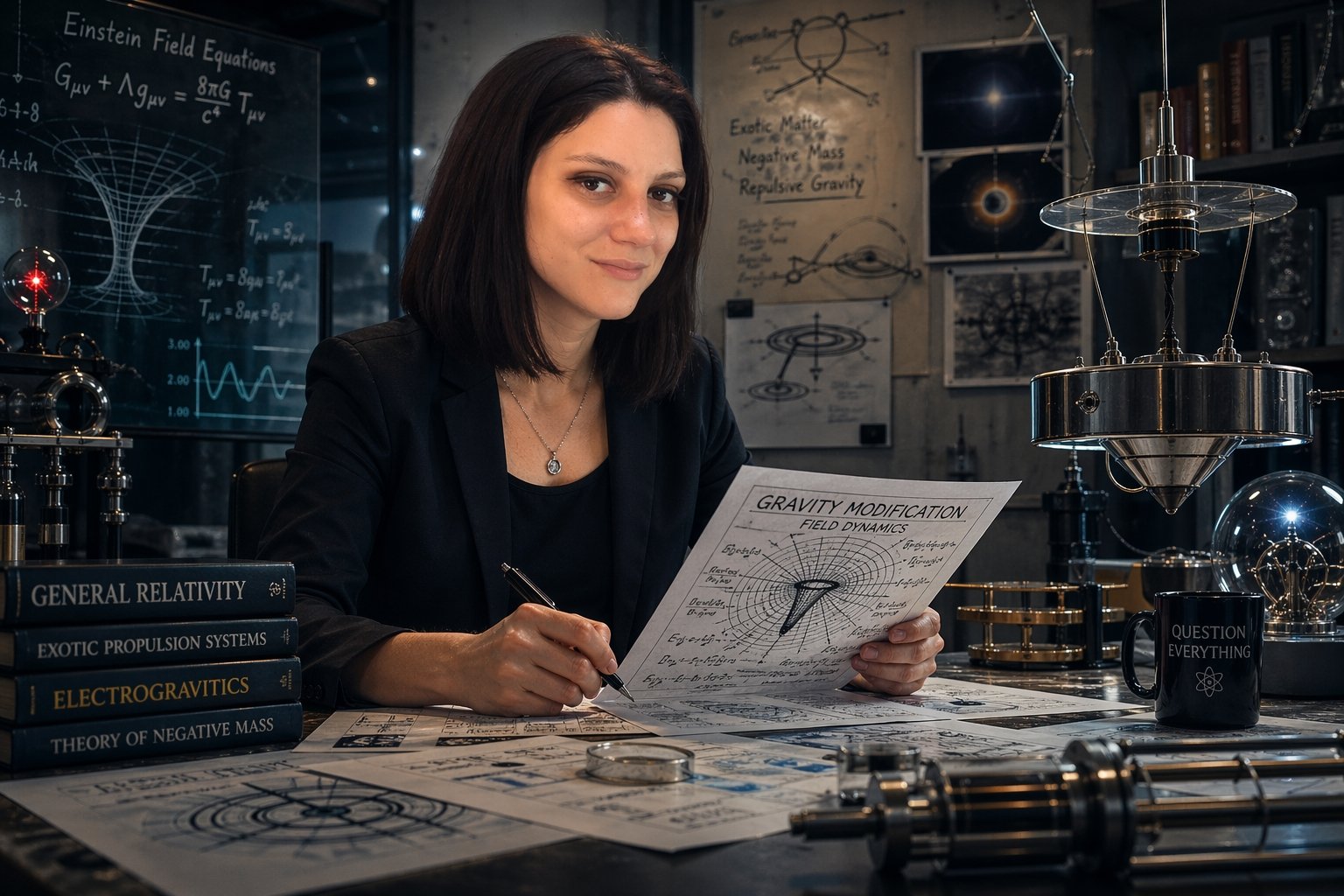
Amy Eskridge anti-gravity is a search topic that blends fringe physics, real scientific history, and public curiosity. This piece explains who Amy Eskridge was, what antigravity means, and why the subject remains controversial.
Understanding why the name Amy Eskridge has become associated with anti‑gravity involves exploring a unique intersection of biography, physics, history and cultural fascination. Amy Eskridge was a multidisciplinary scientist, entrepreneur and the president of a small research organization who claimed to be working on gravity‑modification technology and publicly discussed releasing her findings. Though her untimely death in 2022 drew media attention and fuelled conspiracy theories, her story also opens a window into the broader human quest to master gravity. This article explains Eskridge’s background, clarifies the meaning of anti‑gravity, surveys the long history of similar claims, summarizes modern research and mainstream scientific skepticism, and discusses how public fascination and ethical questions intersect around this topic.
Amy Catherine Eskridge was born in the late 1980s and grew up in Huntsville, Alabama. She studied at the University of Alabama in Huntsville, where she double‑majored in chemistry and biology. Eskridge’s training did not stop there; obituaries and social‑media profiles described her as an “interdisciplinarian” who pursued electrical engineering, physics and genetic engineering. Her diverse education reflects a restless curiosity rather than a narrow specialization.
Eskridge’s professional life blended entrepreneurship and research. She held leadership and technical positions at several startups and research organizations. She served as CEO and president of HoloChron Engineering, a public‑benefit corporation she co‑founded with her father, retired NASA engineer Richard Eskridge. HoloChron described itself as working on quantum computing, gravity modification and metamaterials. Amy also chaired the Institute for Exotic Science (sometimes called the Institute for Exotic Physics). The institute was meant to be a public‑facing platform for research into unconventional propulsion and exotic physics; in a 2020 interview she said she formed it “as a public‑facing persona to disclose antigravity technology”.
What made Eskridge especially intriguing was her willingness to discuss anti‑gravity openly. She claimed to be close to publishing foundational research but said she needed NASA’s approval before doing so. She also stated that threats against her had been escalating and that she hoped going public would provide some protection. On June 11 2022, she was found dead in Huntsville, allegedly from a self‑inflicted gunshot wound; the case remains sensitive due to incomplete public reports and online speculation. Renewed attention in 2026, following several unrelated disappearances of scientists, further amplified interest.
HoloChron Engineering, co‑founded by Amy Eskridge and her father, advertised research and development in quantum computing, metamaterials and gravity modification. Because little documentation survives, it is unclear what specific experiments were conducted. Presentations by Amy and Richard to space‑science organizations described early antigravity experiments and proposals for gravity‑modification devices. The company was structured as a public‑benefit corporation, meaning it was intended to pursue a mission beyond profit. Its dual focus on advanced physics and public outreach set it apart from purely commercial ventures.
The Institute for Exotic Science (IFS) functioned as HoloChron’s educational and outreach arm. In the HAL5 presentation, “A Historical Perspective on Anti‑Gravity Technology,” Eskridge listed herself as “President – The Institute for Exotic Science” and outlined a wide‑ranging review of antigravity history and theory. The institute attempted to create a network of researchers exploring non‑mainstream propulsion concepts and to provide a vehicle for public disclosure. The website disappeared shortly after her death, feeding speculation that it contained sensitive material. Nonetheless, archived materials show that the institute focused on summarizing past antigravity claims, advocating for independent funding and urging transparency in research.
Gravity is one of the four fundamental forces of nature. It arises from the presence of mass and energy and acts between all particles and bodies. In Eskridge’s presentation, gravity was defined as a fundamental force “responsible for interactions which occur because of mass between particles, between aggregations of matter (such as stars and planets), and between particles and aggregations of matter,” dominating at macroscopic distances. Newton’s law describes gravity as an attractive force proportional to mass and inversely proportional to the square of distance, while Einstein’s general relativity treats gravity as a curvature of space‑time. General relativity predicts gravitational waves and phenomena like black holes but leaves open questions about unifying gravity with quantum mechanics.
In everyday conversation, anti‑gravity suggests cancelling or reversing gravity so that objects float freely. The presentation defined antigravity as “reducing, canceling or protecting against the effect of gravity”. This concept has long captivated inventors and science‑fiction writers. However, under general relativity, producing true antigravity would require negative mass—an exotic form of matter that would respond oppositely to gravitational forces. No evidence for negative mass exists. Science News explains that negative mass objects would behave counterintuitively (for example, a negative mass bullet would accelerate through a wall instead of rebounding) and that there is no reason to believe such matter exists.
Many people mistakenly believe NASA trains astronauts in antigravity chambers. Scientific American notes that “there is no such thing as antigravity” and explains that weightlessness on aircraft is achieved through parabolic flights, where the plane and passengers are in free fall. Astronauts “float” because both they and their environment accelerate toward Earth at the same rate. True antigravity would require a force that repels matter or shields an object from gravitational attraction. So far, no technology can neutralize gravity. Instead, spacecraft design uses rotation to simulate gravity via centripetal force, or parabolic flights to achieve temporary weightlessness.
The idea of beating gravity predates modern physics. Eskridge’s presentation gives a whirlwind survey of historical experiments and devices, many of which were later debunked or remain unverified. Understanding these episodes provides context for present‑day claims.
In the 1920s, inventor Thomas Townsend Brown and his former professor Paul Biefeld proposed that high‑voltage capacitors could produce thrust without propellant—an effect called electrogravitics or the Biefeld‑Brown effect. Brown built a device he called the Gravitator. Experiments suggested it produced small lifting forces, but later analysis showed that the effect was due to ion wind rather than any gravitational manipulation. Brown nonetheless patented his “electrokinetic apparatus” in 1960, attracting interest from aerospace companies but failing to produce practical propulsion.
Nikola Tesla, best known for his work on alternating current, filed a 1928 patent for a “space drive” that he described as an anti‑electromagnetic propulsion system. Tesla’s Dynamic Theory of Gravity posited that matter arises from whirls of ether and dismissed curved space‑time. Mainstream physicists rejected these ideas; nonetheless, Tesla’s fame helped entrench antigravity in popular imagination.
In 1948, businessman Roger Babson founded the Gravity Research Foundation, motivated partly by his sister’s drowning (he blamed gravity for pulling her down). The foundation offers annual prizes for essays on gravitation and has recognized work by scientists such as Stephen Hawking. While Babson hoped for practical antigravity devices, the foundation now focuses on theoretical gravity research and does not support fringe propulsion schemes.
The mid‑twentieth century saw a flurry of inventions claiming to defeat gravity. British inventor John Searl promoted the Searl generator, which he said combined antigravity and free energy; it involved concentric rings of magnets spinning around a central magnet. Searl claimed the device levitated, but independent tests have not reproduced the effect, and mainstream scientists classify it as pseudoscience.
American engineer Norman Dean patented a “reactionless thruster” known as the Dean drive, a linear oscillator he said produced unidirectional thrust without expelling mass. Demonstrations produced small forces, but investigators attributed them to friction with the ground or tabletop. Since Newton’s third law forbids reactionless propulsion in free space, the Dean drive never passed scientific scrutiny.
Other devices include Charles Wallace’s spinning discs and Eric Laithwaite’s gyroscopes. Wallace’s machine involved spinning brass discs said to align nuclear spins to produce a “kinemassic field”; like earlier devices, it remained unsubstantiated. Laithwaite, inventor of magnetic‑levitation trains, proposed that spinning gyroscopes could reduce weight. He later acknowledged that Newton’s laws fully explained the observed forces and that no gravitational shielding occurred.
After the Second World War, some defense laboratories pursued exotic propulsion. According to Eskridge’s presentation, the U.S. Aeronautical Research Laboratory at Wright‑Patterson Air Force Base and the Research Institute for Advanced Study (which later became part of Lockheed’s Skunk Works) investigated antigravity in the 1950s. In 1973, the Mansfield Amendment restricted Department of Defense funding for basic science unrelated to military applications. Eskridge argued that this pushed antigravity research into the private sector or classified programs. Claims about secret government work continue to circulate, but little verifiable evidence exists.
Physicist Jim Woodward proposed that applying oscillating power to a piezoelectric material could produce a tiny net thrust through Mach’s principle, which relates inertia to the distribution of mass in the universe. Woodward’s Mach‑effect thruster (sometimes called a Woodward effect device) has been tested by several labs. NASA’s Breakthrough Propulsion Physics program evaluated it during the 1990s but could not conclusively verify the thrust. More recent experiments claim small forces, but the effect remains controversial and has not achieved peer‑reviewed replication.
In the 1990s, University of Alabama in Huntsville scientist Ning Li and colleague Douglas Torr theorized that a rotating superconducting ring in a magnetic field could produce gravitomagnetic and gravitoelectric effects. They proposed that aligning ion spins in a superconductor would create a weak repulsive force. A 1999 article in Popular Mechanics popularized the idea, and NASA’s Marshall Space Flight Center collaborated on experiments around 1996. Li later left UAH to form AC Gravity LLC and reportedly received a $500,000 Department of Defense contract. However, no peer‑reviewed data demonstrating gravity reduction have been published.
In the 1990s, Russian engineer Eugene Podkletnov claimed that a spinning superconducting disc made from YBCO (yttrium barium copper oxide) could reduce the weight of objects placed above it by up to 2 percent. The claim generated media attention and a 2001 patent, but the scientific community criticized the work for lack of reproducibility. NASA explored a collaboration, but subsequent tests did not confirm the effect. French researcher Claude Poher later attempted to reproduce the phenomenon using high‑voltage discharges and reported small thrusts, yet mainstream physicists remain unconvinced.
The Hutchison effect, discovered by Canadian inventor John Hutchison in the 1970s, refers to alleged levitation and fusion of metal objects when multiple electromagnetic fields are combined. Videos show floating objects, but independent attempts to reproduce the effect have failed. The phenomenon is widely considered a hoax.
The Morningstar Applied Physics group, led by Paul Murad and John Brandenburg, modified Searl’s machine and claimed a 7 percent weight reduction. Boeing’s Phantom Works reportedly ran a Gravity Research for Advanced Propulsion (GRASP) program in the 2010s, though details remain scarce. Conspiracy theorists sometimes connect these projects to secret aircraft like the “TR‑3B,” yet no credible evidence supports such claims.
Overall, while a handful of engineers and physicists have explored ways to manipulate inertia or gravitational fields, none have produced reproducible, peer‑reviewed demonstrations of true antigravity. The mainstream view remains that general relativity prohibits gravitational repulsion without exotic matter and that claims to the contrary lack empirical support.
Scientists emphasize that weightlessness is not the same as antigravity. The Scientific American article “Fact or Fiction?: Antigravity Chambers Exist” explains that there is no technology to neutralize gravity and that the sensation of weightlessness experienced by astronauts comes from free‑fall conditions. On parabolic flights, often called “vomit comets,” an aircraft flies a series of arcs; during the downward portion, passengers and objects inside experience microgravity for 20–30 seconds. Astronauts train on such flights because Earth‑based antigravity chambers do not exist.
Furthermore, theoretical discussions about negative mass—matter that would accelerate opposite to applied forces—remain speculative. Science News notes that no evidence for negative mass has been found and that even if it existed, using it to neutralize Earth’s gravity would require enormous quantities—on the order of the mass of a small asteroid per square meter. A negative mass apple would still fall toward Earth due to the unusual dynamics of gravitational forces. The article illustrates how negative mass leads to paradoxical behaviours and concludes that antigravity remains science fiction for now.
This skepticism extends to claims like the Biefeld‑Brown effect, the Dean drive, AC gravity and Podkletnov’s disc. Physicists argue that Newton’s laws and conservation of momentum forbid reactionless drives; if a device appears to generate thrust, one must account for electromagnetic forces, thermal effects, vibration or measurement error. Peer review and independent replication are essential. Without reproducible results, claims remain outside accepted science.
When Amy Eskridge died in 2022, rumours quickly circulated. News reports described her death as a self‑inflicted gunshot wound but noted that police and medical examiners released no public investigative report. Eskridge’s openness about antigravity, her warnings of threats and the abrupt disappearance of the Institute for Exotic Science website fuelled speculation. In 2026, when several scientists in unrelated fields went missing or were found dead, online sleuths created lists linking their cases to Eskridge and suggesting foul play. Even former President Donald Trump commented that the cluster of deaths was “pretty serious stuff” and said investigations were underway.
Conspiracy theorists draw connections between Eskridge’s claims, black‑budget research and UFO‑related programs. They point to the government’s Advanced Aviation Threat Identification Program (AATIP) declassification and suggest that antigravity devices already exist. It is worth noting that sensational theories often rely on incomplete information and ignore simpler explanations such as mental health issues, accidents or coincidences. Authorities have not linked Eskridge’s death to any broader pattern. Her own statements about publishing research may have been aspirational rather than evidence of secret discoveries. Responsible analysis requires caution: extraordinary claims demand extraordinary evidence.
The dream of antigravity stems from practical and philosophical motivations. On a practical level, eliminating or reducing gravity could revolutionize transportation, energy and space exploration. Propellant‑less propulsion would reduce fuel costs and enable long‑duration missions. Shields against gravity could facilitate levitation and new forms of architecture. On a philosophical level, antigravity represents humanity’s desire to overcome natural limits. Early religious myths and modern science fiction alike envision flying cities and gravity‑defying vehicles.
Because antigravity research sits at the fringe of physics, it attracts both genuine innovators and charlatans. Pseudoscience flourishes when results are not subjected to rigorous peer review. Inventors may misinterpret electromagnetic effects or measurement errors as breakthroughs. Others may knowingly promote false devices for publicity or funding. To avoid repeating past mistakes, researchers should adopt transparent experimental protocols, publish data and welcome replication efforts. Claims should be evaluated by qualified physicists rather than by enthusiasts with little training.
Secrecy poses additional ethical issues. Historically, defense agencies have funded classified research into exotic propulsion. While national security sometimes requires secrecy, suppressing scientific findings can hinder independent verification and fuel conspiracy theories. If legitimate gravity‑modification technology were discovered, society would need an open conversation about its applications. Should it be used for peaceful space travel, or would it spark an arms race? Public engagement and oversight could help ensure ethical use.
The speculation surrounding Eskridge’s death illustrates how quickly narratives can form around emerging technologies. Researchers working on controversial topics may face harassment or threats. Institutions should support the mental well‑being and security of scientists, promote clear communication, and discourage sensationalism. At the same time, responsible media coverage can inform the public without sensationalizing tragedies. Highlighting the distinction between credible research and unfounded claims helps protect both science and scientists.
The story of Amy Eskridge intertwines personal ambition, frontier science and cultural imagination. As a young entrepreneur and scientist, she sought to bridge public outreach and esoteric research, championing transparency and interdisciplinary work. Her death and the disappearance of her institute remain enigmatic, but they do not provide evidence of secret antigravity breakthroughs. The broader history of antigravity is filled with intriguing ideas and unsubstantiated claims. Physics tells us that canceling gravity requires exotic conditions not yet observed, and mainstream research continues to focus on understanding gravity within general relativity and quantum theory. For now, weightlessness comes from free fall, not antigravity, and the dream of levitation remains part of science fiction.
Curiosity about antigravity continues to inspire inventors, storytellers and researchers. Exploring the history and science behind the concept helps separate fact from fiction and reminds us that extraordinary progress often arises from rigorous inquiry rather than wishful thinking. Those intrigued by exotic propulsion might explore related topics—such as artificial gravity in rotating habitats, space elevators, or the challenges of deep‑space propulsion—where current physics and engineering provide fertile ground for innovation. By understanding past efforts and present limitations, we can better guide future discoveries.